- September 03, 2026
- By GB Enterprises
C Purlins: Efficient Structural Support for Modern Steel Buildings
Steel buildings do not hold themselves up on their own. Behind every warehouse roof and factory wall, there is a secondary framing system doing the real day-to-day work. C Purlins are a big part of that system. They sit between the primary frames and take on the load from roof sheets and wall cladding, passing it safely to the main structure. Get this selection right, and the rest of the build tends to fall into place. Get it wrong, and you are looking at rework, delays or performance issues that could have been avoided. This guide covers the basics — what these sections are, where they go, how they are made and what to check before you order.
Building the Right Secondary Framework for Steel Structures
Walk into any large warehouse, factory shed or pre-engineered building, and you will see the same thing overhead — a grid of steel sections running between the main columns and rafters. That grid is the secondary framework, and it does more than just fill space. It transfers roof and wall loads back to the primary structure in a controlled, predictable way.
For a long time, heavier structural sections were the default choice. Cold-formed steel changed that thinking. It is lighter, easier to handle on site and puts material only where the cross-section actually needs it. For builders working against deadlines, that weight saving translates into faster installation and less strain on the crew. GB Enterprises manufactures cold-rolled C and Z purlins for pre-engineered building applications, giving construction teams a practical framing option backed by controlled production.
C Purlins for Reliable Roof and Wall Support
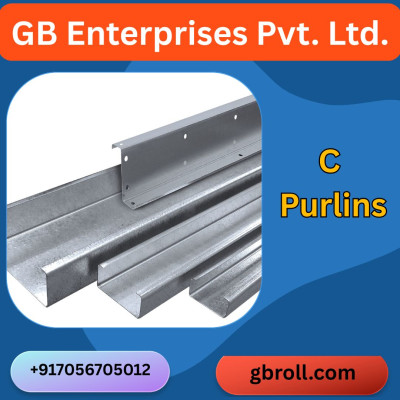
Take a cross-section of a C Purlin, and you will see exactly where the name comes from — it looks like the letter C. These cold-formed sections are fixed between primary frames and do the work of carrying roof sheets, wall cladding panels and the assorted loads that come with them over time.
Being lighter than traditional structural sections, they are simpler to lift, position and fix. That said, lighter does not mean one size fits all. The correct section for any job depends on span, spacing, thickness, steel grade and what the structure is actually expected to carry. No reputable engineer picks a purlin by guessing. The numbers have to work.
Where These Steel Sections Fit Into Modern Construction
These sections show up in more building types than most people realise:
- Pre-engineered buildings
- Industrial warehouses and factories
- Commercial and agricultural sheds
- Cold-storage facilities
- Wall-cladding systems
- Roofing frameworks
- Simple-span secondary framing applications
The requirements are not the same across all these uses. Roof purlins deal mainly with the weight of sheeting, wind uplift and rain loads. Wall girts face horizontal wind pressure and support cladding panels. Simple-span applications bring their own loading patterns. Each setting asks something different of the section, which is why span, spacing, and design loads matter so much in the selection process.
From Steel Coil to Precisely Formed Structural Sections
The process starts with a flat coil of steel. That coil feeds through a series of rollers, and each roller bends the material a fraction more than the last. By the time the strip exits the line, it has taken on the full C profile. There is no hammering or pressing involved — just gradual, continuous shaping.
This method produces sections that are consistent from one end to the other and from one batch to the next. For site teams, that consistency matters. When every purlin comes out to the same dimensions, connections line up properly, and erection stays on schedule. Where drawings call for it, holes are punched at the factory so site crews are not drilling their own, which saves time and reduces the chance of misaligned fixings. GB Enterprises pays close attention to dimensional accuracy across its PEB purlin range, offering different thicknesses, web sizes, GSM coatings and tensile-strength grades. Sections go through checks on straightness, dimensions, coating and punching before they leave the facility.
Why GB Enterprises Is a Practical Choice for PEB Purlins
GB Enterprises carries a dedicated range of C and Z purlins under its pre-engineered building line. As a Z Purlin Manufacturer with over two decades in the business, the company supplies sections in varied thicknesses, web dimensions, GSM coatings and tensile strength grades — matched to what each project actually calls for rather than a fixed catalogue.
The production setup behind this is worth knowing about. GB Enterprises has been operating since 2003, runs a 165,000 sq. ft. manufacturing facility, operates more than 40 roll-forming machines and holds a stated monthly output of around 3,500 MT. For procurement teams and PEB contractors placing bulk orders, that scale means supply is predictable, repeat orders come out consistently, and project timelines are easier to plan around.
Build Your Next Steel Structure With the Right Support System
It's not always the lowest price that matters when choosing a purlin. It's about the structural needs, the site conditions, the right size, and the quality of the construction. When you cut corners at this point, they usually show up later in ways that cost more to fix. GB Enterprises wants to talk to you about what you need if you are a contractor, PEB manufacturer, engineer, or procurement team working on a project. Talk to your supplier about sections, sizes, coatings, punching needs, and bulk quantities, and make sure they can deliver what the drawings show.
FAQs
Can C-shaped purlins be used for both roof and wall support?
Yes, the same section can work for both roof framing and wall girts. What determines suitability is the structural design, the actual loads at play and the connection arrangement specified for that building.
How do I decide between a C purlin and a Z purlin for a PEB?
C Purlins work well for simple-span situations, end bays and wall applications. Z sections suit designs where members overlap across supports. The better fit depends on how the structure is designed, not on a general preference.
Does a heavier purlin always mean a stronger steel building?
Not at all. What matters is section geometry, steel grade, thickness, span, spacing and how the loads are engineered. A heavier section selected without calculation is not a safer choice — it may just be an expensive one.
Why are factory-punched purlins useful during steel-building installation?
Pre-punched holes mean site teams spend less time drilling and measuring. Members go up faster, connections land where they should, and the erection process runs more smoothly overall.
What coating should be considered when purlins are used in humid or corrosive environments?
The environment at the site should drive the coating specification. Humid, coastal or chemically exposed locations need a higher level of protection. Buyers should specify the coating they need rather than assuming all coated sections offer the same performance.